Core questions



Opti-pessimism is a series of challenge prompts around 4 key principles inspired by two core conceptual questions:
- What are the worst consequences if your product or project is successful?
- What are the best ways that you can respond to an unforeseen major problem?
Opti-Pessimistic Talks
In this 2019 keynote for Interaction Latin America, Cheryl Platz delivers an updated take on Opti-Pessimism and how it applied to the growing impact of artificial intelligence on our lives: a surprisingly clear and early warning signal about what was to come two years later with the advent of Chat-GPT and large language models. But rather than fearmonger, Cheryl leaves her audience with concrete steps on how to conquer these metaphorical elephants when they enter the room.
Additional talks featuring Opti-Pessimism from Cheryl Platz – the debut talk from DEVit 2018 in Thessaloniki, Greece and a 2022 virtual talk called “Should You Build It” where Cheryl introduces a companion framework, PICS (Problem, Inclusion, Context, Systems) for further deconstructing tough problems at the start.
Opti-pessimism: Design, AI, and our uncertain future (2019)
Future foreshadowing, now realized
Cheryl Platz has been providing helpful context to designers for nearly a decade about how to weather the coming AI storm, but the world wasn’t ready. Are you ready now?
“Software designers implementing artificial intelligence face many choices, but one particularly crucial decision is this: Will my artificial intelligence help a human decide to take action? OR will my AI-powered system be empowered to act on its own?”

Artificial intelligence leads to uncertain outcomes. What does this mean for our approach to product design?
Medium Article Takeaways
- AI is not a monolith
- Machine learning is not AI
- Failing fast is dangerous at scale
- Opti-pessimism helps cope with scale
- Boeing MCAS case study
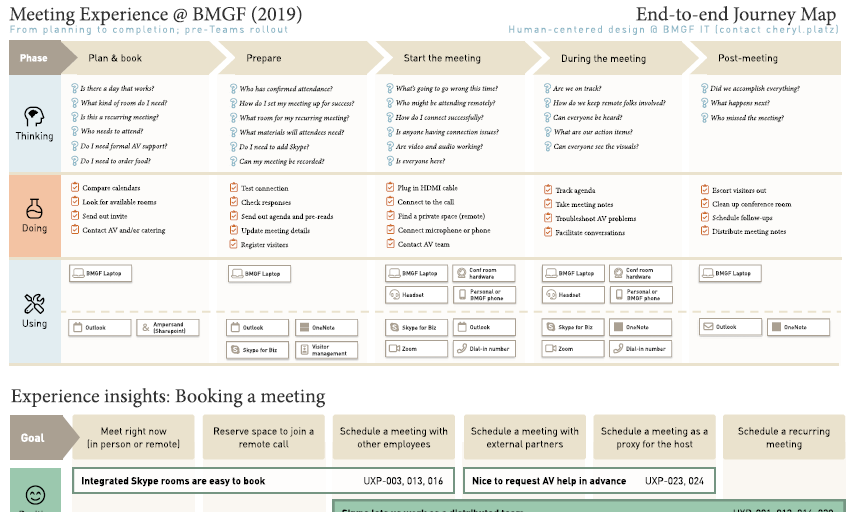
Techniques for designing in unprecedented times
Article Takeaways
- Opti-pessimism is a practical tool
- Opti-pessimism helped Cheryl develop a proposal for accelerating the replacement of the Gates Foundation’s remote conferencing solution just in time for the pandemic without knowing it was coming
- Opti-pessimism helped Cheryl accurately predict pain points in the Riot Games + Xbox Game Pass project and plan for them, yielding an on-time holiday release for millions of players with no major issues
Opti-Pessimistic Design at Scale: Finding the Best in the Worst (2025)
Case Studies in Applied Opti-Pessimism
Seven years after she first brought the concept to the world stage, Cheryl Platz returned to the Design Matters stage to deliver a keynote with case studies on applied opti-pessimism at the Gates Foundation and Riot Games. Read more about the case studies she shared in this companion magazine article.
“I did not know a pandemic was coming. I did not know my research would enable us to make Teams the global standard two weeks before the foundation closed for the pandemic… but I DID know that it was a good idea to ensure we were well-positioned to respond to unforeseen problems quickly and confidently, and since meetings are the heart of that business, so too was this work. I didn’t need to be psychic to help ensure life-saving work continued in critical conditions. I just needed to be opti-pessimistic.”
Opti-Pessimism in Print: Cheryl’s Books

“Unlike movies, board games, and tabletop roleplaying games, video games are large, complex software projects that carry operational costs during and after launch. They come with a ton of risk, from market mismatch to player data leaks and classic server failures. In Jesse Schell’s The Art Of Game Design: A Book Of Lenses, Risk Mitigation is Lens #16. I introduced a concept called “opti-pessimism” in Design Beyond Devices to help people cope with ambiguity with structured catastrophic imagination.”
Cheryl Platz, The Game Development Strategy Guide
Chapter 4, Page 86: Tackling Ambiguity with Opti-Pessimism
Paired with game development specific challenge questions
“If your product caused a human being to lose their job, how would you feel? Can you go to sleep at night knowing that despite your best intent, a seemingly innocuous product caused lasting harm? Would you justify it by saying it was an unfortunate but isolated event?
The trouble is that there’s really no such thing as an isolated “edge case” in a world where experiences are targeting millions—if not billions—of people at a time, and becoming indispensable in the process.
With such a large scale of potential human impact, it’s no longer enough to hide behind good intent or to be satisfied with a “go fast and break things” mentality. It’s critical to use your advanced reasoning skills and creativity—qualities you most certainly possess as a designer— to try and foresee potential problems in advance.”
Cheryl Platz, Design Beyond Devices
Chapter 11, “Opti-Pessimism: Explore the Extremes”
Paired with general purpose challenge prompts
Going Deeper: PICS Or It Shouldn’t Happen
Should you build it? In the final chapter of Design Beyond Devices: Creating Multimodal, Cross-Device Experiences, Cheryl Platz provides another lens for querying whether your idea is too disruptive to thrive. There are infinite possibilities in the creative realm, so ruling out the harmful ones is a gift that points us to better outcomes for you, your business, and your customers. (See above for a talk about the PICS framework.)
P
PROBLEM
Cheryl reminds all of her teams to solve the right problems.
- Who has this need and how did you identify it?
- Are you working on a solution in search of a problem?
- Is there a better use of this time and energy?
- Do your priorities match your values?
I
INCLUSION
In a world where you’re looking to grow your market, why wouldn’t you pursue inclusion? It’s the right thing to do, but it’s also the smart business play. No matter what the current perceptions may be, science is on the side of diverse perspectives pushing more innovative outcomes.
- Does your team include a variety of perspectives?
- When you consult experts, are you taking action on their recommendations?
- Have you explored perspectives beyond fully abled individuals?
- Do your team’s behaviors create a safe space for creativity and collaboration?
C
Change (and consequences)
In philanthropy, Cheryl’s colleagues discussed “theories of change.” When you’re proposing a feature, product, or service, what is your theory of change? Don’t just disrupt for disruption’s sake. Use your skills for good and think about all possible outcomes
- What might success and failure look like?
- What happens if your product or customer goes away?
- How might your solution need to change based on unexpected or emerging conditions?
- What is your theory of change?
S
Systems
Nothing exists in a vacuum. With what systems will your solution connect, communicate, or interact? What and who will be permanently changed? How do time, location, community, and society shape your experience?
- Have you considered your proposed solution in the context of the systems in which it will contribute?
- What systems might be disrupted by your work, and how can you minimize that harm?
- What unintended consequences might your proposal have on the industry, economy, environment, or society at large?
- How will your solution interact with institutionalized racism or other forms of systemic discrimination?
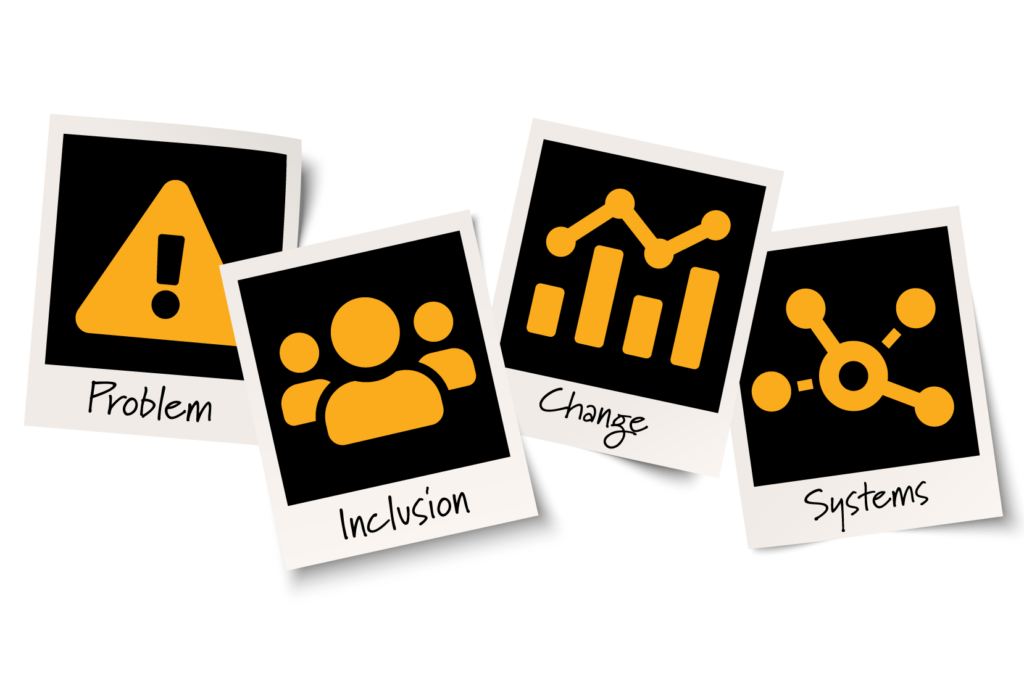
Four instant photos with icons representing “Problem” “inclusion”, “change”, and “systems” – the 4 elements of PICS