Major Media
BBC Radio 4
The Digital Human
Series 15: Subservience
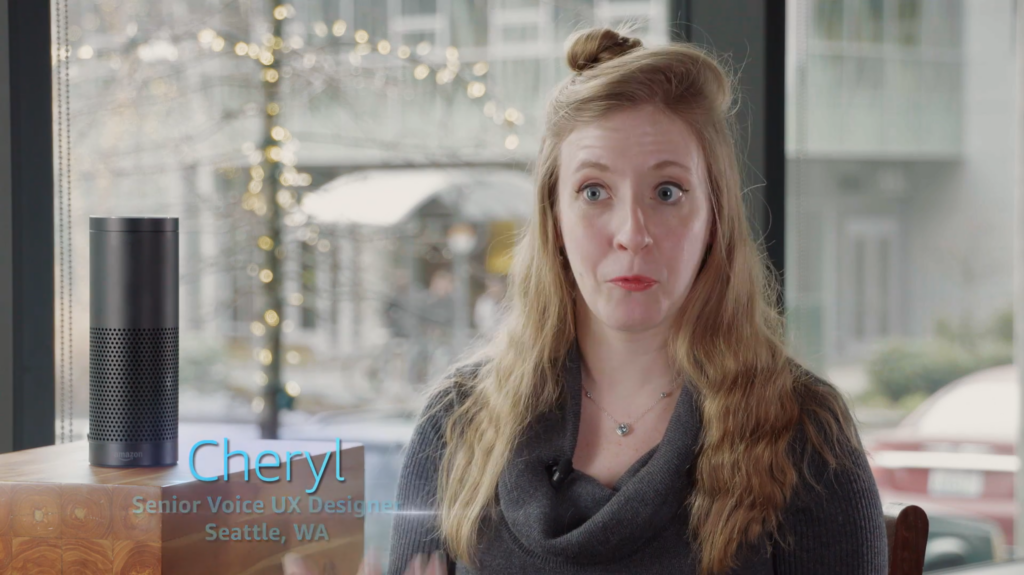
Cheryl was featured as an expert in conversational agents in this discussion about etiquette, digital agents, and the psychological impact of our continued relationship with our devices.

El Colombiano
November 19, 2019
Medellin, Colombia
“Los asistentes virtuales, mucho más que una voz”

Interviews

Microsoft Alumni Network
Leveling Up: How Cheryl Platz turned a lifelong love of Pikachu into a dream role at Pokémon
“By 2007, Cheryl saw the gaming industry shifting. Budgets shrank, handheld titles faded, and UX roles were scarce. So, she made a bold move: Microsoft. “If you live in Redmond and don’t work at Microsoft, there’s a curiosity,” she says. “Where are all those cars going?”
She joined as one of two designers on System Center Configuration Manager, later leading design for Windows Automotive features like voice UI and notifications. “I bewildered all my game friends,” Cheryl said. “‘You went from Winnie the Pooh to server tools?’ Yes—and I loved it.”
Craig Fox, principal design director for Microsoft Azure, was her direct manager on the Connected Car team. While most people at Microsoft are “already psychologically oriented” to be high performers, Craig said Cheryl was mind blowing. “Here’s a person who has the human-computer interaction degree, she’s not just a computer science person—she can sing and act and present comfortably in front of crowds,” he said. “She’s multifaceted. Her energy, network, and communication served her and the team very well.”
Post was originally public but has moved behind a paywall; you can read the article here on this site.

You mentioned earlier working on high-profile projects at companies like Microsoft and Amazon. How did your experience in big tech shape the way you approached writing this book?
What a great question! And that’s part of the answer: leading with curiosity. Coming from big organizations where lots of people would assume things were bad or incorrect for a reason, I discovered time and time again that asking the right questions often led to surprising answers. “Has anyone ever documented this?” “Did anyone mean for this character to look this way?” It’s shocking how often the answer is “no, this wasn’t intended.” That has led me to bring curiosity into all of my work. I ended up with SO many footnotes and references because I was constantly looking for more information, more input, more ways to strengthen my hypotheses and the content I was sharing. My editor was very patient. But the other part is a focus on collaboration. As a veteran leader in large organizations, I have seen the power of driving shared understanding across teams and disciplines. I have also seen what happens when teams break down too far into silos because they don’t understand their roles and start fighting over work. I want this book to make it easy to approach someone from any discipline and ask good questions, to build relationships, to get to a shared understanding of the game you’re trying to build together.
If you’re making a live-service or multiplayer game, then thriving will have to account for the unpredictable behavior of players and how you react to the unexpected in real time.
“The future is multimodal. The more we can move to supporting as many modes as possible, the better, so that we don’t leave people behind. If you choose not to support voice on a smartwatch, you’re going to exclude people that don’t have access to sighted abilities for any reason. It could be that there’s too much glare and they can’t see what’s on the screen, or it could be that they’re blind and need a spoken interface.
“Holy grail” experiences allow customers to choose the interaction model based on their needs but that’s still a bit expensive and complicated. I like to challenge folks to think about being flexible and support more input modalities than they do today, as a way to expand their market and be more inclusive. It makes the device more desirable both for people with permanent disabilities and people with temporary disabilities.”
Designing for just one specific device or input type is no longer enough.
But some other proud moments are less glamorous. I spent a year building out a series of design patterns to help the Alexa platform scale to handle notifications and other proactive interruptions like phone calls, which weren’t part of the original interaction model. That work required close partnership with our developers, since it was essentially a roadmap for hardware-agnostic platform changes. I love systems-level work like that, and I hope designers are called to the table more frequently for those design problems in the future.
Clearleft Interview with Cheryl Platz
What advice would you give practitioners who are just starting out in their careers?
Your first few projects will have a disproportionate impact on your later career — and those first few years out of school are a magical time where employers are more willing to forgive a primarily academic portfolio. Choose carefully and optimize for projects that will give you end-to-end experience shipping product OR strong agile design process with plenty of customer interaction.
As I’ve been lucky enough to work on cutting edge products like the Echo Look, I now find early-career designers asking me about how to work on that type of project. My major advice to these designers is to get experience shipping product before seeking out secretive work. A large majority of new projects under NDA are cancelled or indefinitely postponed, which could leave your portfolio in the lurch. Furthermore, working on such projects cuts you off from the greater design community, making it harder to get advice.

Carnegie Mellon Homepage:
Happily ever After
Randy Pausch touched millions through his ‘Last Lecture.’ For Cheryl Platz (CS’02,’03), his impact was direct and personal. Platz first heard Pausch speak at a Carnegie Mellon University admissions presentation.
“I was desperately seeking some way to keep my creative passions alive while pursuing a technology career,” said Platz. “When Randy explained that the Human-Computer Interaction Institute (HCII) was the marriage of visual design, cognitive psychology and computer science, I was sold,” she said. “That interdisciplinary focus is part of CMU’s DNA.”

What’s your design philosophy and how does it manifest in your work?
It’s been a hard won perspective, but: we can be better than the sum of our parts. We are better together. Rather than bring all the answers to the table, bring the right questions to the table — and the drive to see those questions through to fruition. I embrace fluid process, with the right tool in the moment; I embrace the minimum amount of effort required to get to the root of the story; I try to embrace transparency whenever I can. That’s not how I started, but that’s where I am now.
In many ways, we need to be willing to become invisible; to become a conduit for the customers we serve. It’s not glamorous — and I say that knowing it’s ironic, as someone who regularly stands onstage to talk about design. The more we model our customers’ truth, the more we all succeed.
Career Interviews – Legacy
Short interviews from Cheryl’s time at Amazon and Microsoft highlighting key moments in her career.
Podcasts
Featured Topics
- User Experience vs Game Design
- Prosocial and Community Design
- Modern Motivators of Play
- Artificial Intelligence, UX, and Gaming
- Writing and Podcasting Lessons
- Non-linear career paths and personal resilience
UX Fika Podcast: Cheryl Platz on what makes people play
An incredibly in-depth conversation between friends
Cheryl first met UX Fika host and author of Storytelling in Design Anna Dahlström on the European design speaking circuit, and they’ve remained friends ever since. This very transparent conversation explores topics like transcending disability, the role of artificial intelligence in technology, the “why” behind many of Cheryl’s unexpected career pivots that eventually led to a dream role in her current position, and many insights from Cheryl’s new book The Game Development Strategy Guide from a user experience perspective,
O’reilly Design: Cheryl Platz on Designing the Echo Look
From a blank page to the “Clueless” closet
Cheryl was employee #4 and the first designer on the team that created Amazon’s Echo Look, which spent 3 years on the market. Learn what it took to create such an unprecedented device-forward, natural-language powered experience in this fascinating conversation.
Cheryl Talks Interactive Online Theater
In September of 2021, Cheryl created and directed the limited run online improv show “Cupid on Mute.” In this podcast episode, she takes a break from talking tech to discuss her history with asymmetric interactivity at scale in interactive theater, and how it inspired her work on Cupid on Mute, which earned as much in 4 online performances as some physical performances with drastically lower overhead.
VOXPOPCAST: ImproveReality
Popular podcast Topics
- Careers in user experience and gaming
- Design leadership
- Video game design, art, and business
- User experience research and ethnography
- Artificial intelligence
- Applied storytelling
Legacy Design Podcasts
Pop Culture Podcasts
The Ginger Runner
Episode 150
The Walt Disney World Marathon with Linzie Starr and Cheryl Platz
Cheryl once ran an “unplanned marathon” – she’d trained for a half marathon that got cancelled, and ran the marathon the next day. This is the story of Cheryl’s 2017 WDW Marathon.
Hi! I Think You’re Nice!
Episode 46
Pokémon with Cheryl Platz
This was recorded long before Cheryl began working for TPCi. While she can’t be as open now, you can hear her love for the brand from the past here as expressed through ironic foreshadowing.
Expert Opinions
Adobe Ideas Blog: Expert Guest Opinions

Removing Bias in AI Part 1: Diverse Teams and a Refined Design Process
“While team diversity is crucial, you’ll never be able to hire a group of people that completely represent the lived experiences out there in the world. Bias is inevitable, and Cheryl Platz therefore advises that you must also redefine your process to minimize the potential harm caused by your AI-powered system, and develop proactive plans that let you respond to issues and learn from input as fast as possible. She calls this new mindset “opti-pessimism“: be optimistic about the potential success of your system, but fully explore the negative consequences of that success.
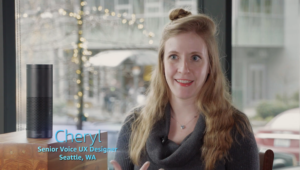
Ask a UXpert: Designing for Headless Interfaces
“What can we infer by a customer’s change in context? Once you’ve identified these key elements, don’t shy away from getting involved early in product design and architectural discussions to ensure you can share that customer state across devices. Once we’ve begun tackling those transcendent scenarios, we turn our eyes towards the design process. Successful design for headless or multimodal user experiences is heavily dependent upon context. How are you capturing customer context in your research and deliverables? It’s often not enough to just share scripts or flows. Storyboarding can be critical in communicating the richness of your customer’s lived experience at the moment they speak to your product. High-fidelity prototyping may require video or audio components.”